

Men fined for skipping Friday prayers in Malaysian state
State officials say banners will be put up in mosques to remind worshippers of their “obligation”
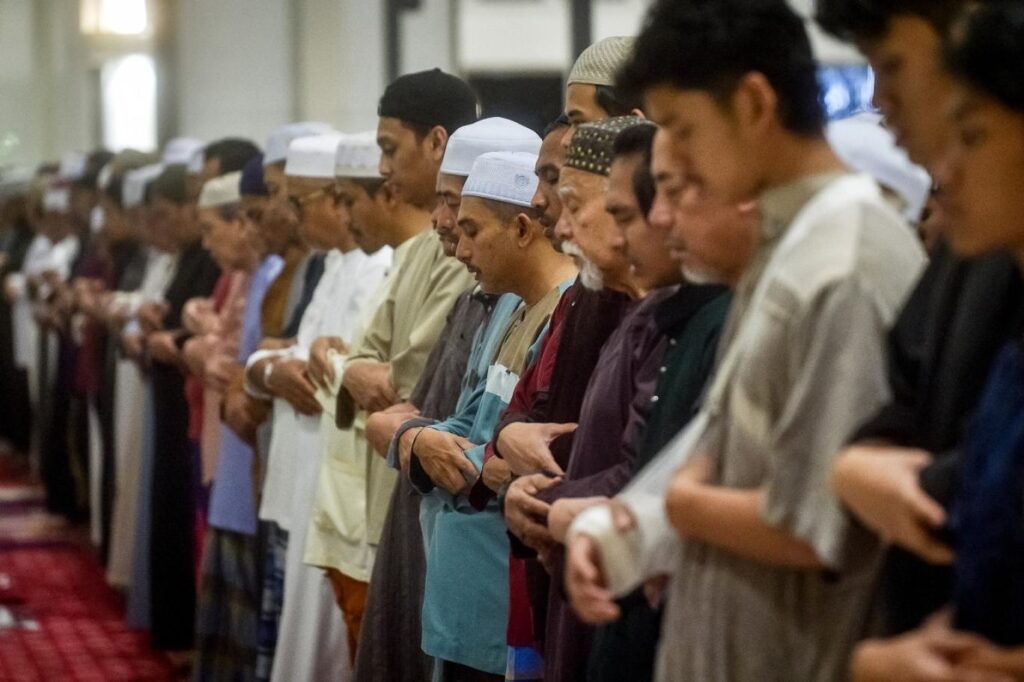
A prayer scene at a mosque in the Malaysian city of Putrajaya on March 1 (AFP)
Muslim men in a Malaysian state could face up to two years in prison or a hefty fine under sharia law for skipping Friday prayers without a valid reason.
Authorities in Terengganu state, which is governed by the conservative Pan-Malaysian Islamic Party (PSA), announced on Monday that violators would be punished under the Sharia Criminal Offences Act with a jail term or a fine of up to 3,000 ringgit (200,000 Pakistani rupees), or both.
Terengganu state executive council member Muhammad Khalil Abdul Hadi warned that even missing Friday prayers once would be a punishable offence.
Previously, only those who missed three consecutive Friday prayers were punished.
He said, according to Malaysian newspaper Berita Harian: “This reminder is important because Friday prayers are not only a religious symbol but also a manifestation of obedience among Muslims, so punishment will only be given if people are reminded to pray Friday prayers, but they still neglect this duty.”
He said the state government would put up banners at mosques to remind people of the importance of praying Friday prayers, and that the campaign was launched to raise public awareness of the law.
He further warned that action against men who skip prayers could be taken through public reports or patrols.
The enforcement in Terengganu reflects a wider effort by the PSA to enforce stricter interpretations of Islamic law in Malaysia.
The party, which is the largest party in Malaysia’s parliament and the ruling party in four of the country’s 13 states, has long advocated toughening religious punishments and at one time tried to introduce a criminal code called Hudud, which included punishments such as amputation of hands for theft and stoning for adultery.
The announcement sparked backlash on social media.
Lawyer Azira Aziz wrote on X: “Where did the claim that there is no coercion in Islam go, or is this a reflection of how few Terengganu men attend Friday prayers?”
She wrote: “No one disputes that Friday prayers are obligatory, I just think it was unnecessary to include it in the law as a crime. Advocacy and awareness programs would have been sufficient.”
Malaysia’s legal system is divided into two parts, with Sharia law governing the personal and family affairs of Muslims, while civil laws also exist.
Malaysia’s ethnic Malays – all of whom are considered Muslims under Malaysian law – make up two-thirds of the country’s 33 million population, and there are also large Chinese and Indian minorities.
Sharia is Islamic law, based on the Quran and hadith.
Last November, Johor state’s top Islamic official said the state would also take enforcement measures to ensure that all Muslim men attend Friday prayers.
Malaysia’s highest court struck down dozens of sharia-based state laws in February 2024, sparking a backlash from Islamists who feared it could undermine religious courts across the country.
The 16 laws enacted by the government of the opposition state of Kelantan included penalties for crimes such as homosexuality, sexual harassment, incest, changing clothes and perjury.
The court said the state cannot make Islamic laws on these issues because they fall under Malaysian federal laws. PAS then staged a massive protest outside the court, demanding the protection of Sharia law.