
New research shows that the thermal expansion of metals causes the Eiffel Tower to grow about 12 to 15 centimeters higher on summer days than on cold winter days.
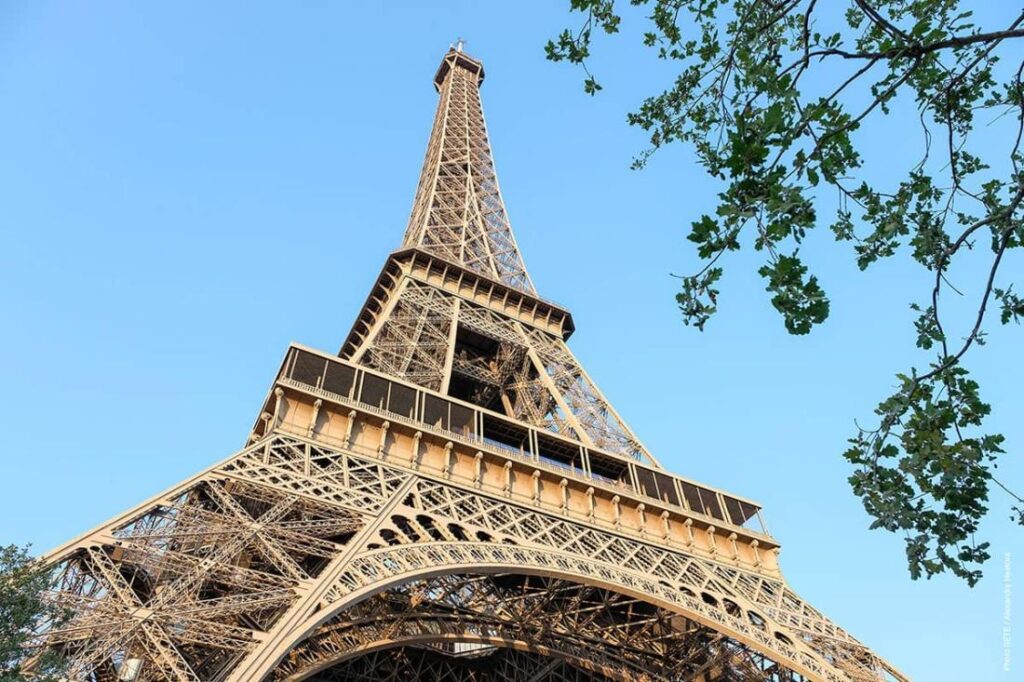
According to “Online Information” and cited by Estadi Find, the tower that is known today as the “Eiffel Tower” was initially called the “300 meter tower”, a name suggested to Gustave Eiffel by engineers Maurice Cochlan and Émile Nogier. This name indicated from the beginning that the goal was to create a structure with an extraordinary, record-breaking height.
Surprisingly, in summer, as the temperature rises, the Eiffel Tower grows taller than its original size. This phenomenon is due to *thermal expansion*, the same physical property that causes most substances to expand in the heat and contract in the cold.
Gustave Eiffel used malleable iron, a strong but lightweight material, to build the tower. This allowed them to build a structure weighing 7,300 tons, weighing roughly the same as the volume of the air it contains. This property allows the tower to remain stable despite horizontal pressures such as wind.
Metals, including iron, expand more than ceramics and glass, but less than polymers. The iron used in the tower has an expansion coefficient of about 12 per 10 degrees Celsius; that is, a one-meter rod will expand about 12 microns for every degree increase in temperature, which is less than the thickness of a human hair.
However, when we consider this increase in length in the tower’s 300-meter dimensions and the temperatures of Paris (from minus 20 to 40 degrees Celsius and even up to 70 degrees Celsius in direct sunlight), the result becomes significant. Calculations show that the Eiffel Tower is about 12 to 15 centimeters higher in summer than in winter, and because one side of it is hotter, it also tilts slightly towards the side away from the sun.
Thus, the Eiffel Tower is not only a symbol of Paris and a masterpiece of engineering, but also a giant thermometer.